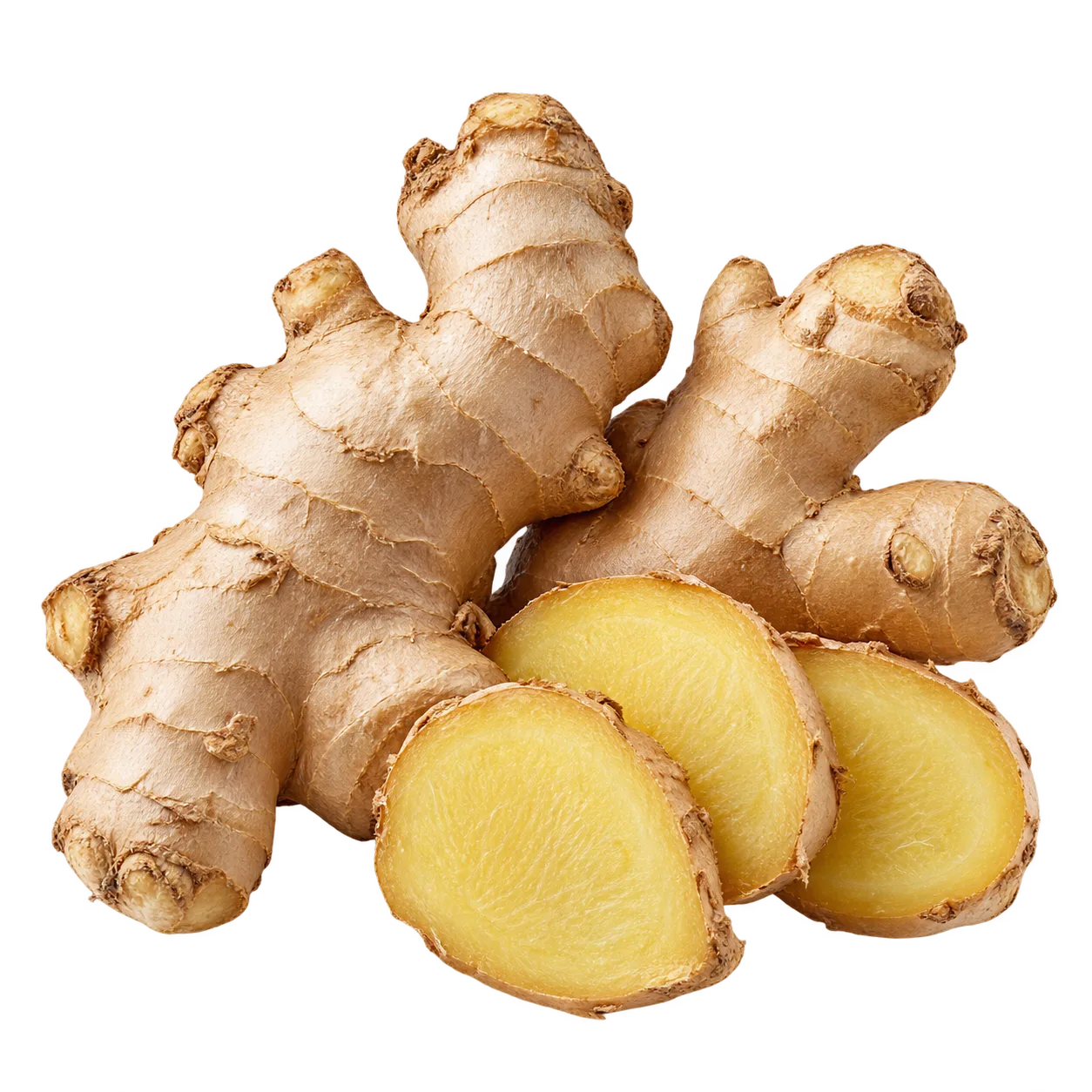
Open almost any respiratory supplement page and ginger appears, trailing a vague reference to "clinical research." There is a real study underneath that phrase. There is also a reason the companies citing it never quote the second half.
What was actually done
Researchers at Columbia University wanted an answer to one narrow question: put ginger directly against airway tissue, and does anything happen? They worked with small strips of human airway smooth muscle, applied a chemical to force them into contraction — the laboratory stand-in for an airway tightening — and then introduced food-grade ginger.
The strips loosened. Raise the concentration and they loosened further.
Which molecules did it
Ginger is a crowd of compounds, so the team isolated them and went one at a time. Three produced the effect: 6-gingerol, 8-gingerol and 6-shogaol. A fourth, 10-gingerol, produced nothing whatsoever.
That fourth result is the most valuable line in the paper and the one nobody quotes. An effect that distinguishes between closely related molecules is behaving like pharmacology. An effect that appears no matter what you drop in the bath is usually an artefact of the method.
Later work pointed at a mechanism — inhibition of two enzymes involved in holding airway muscle contracted — and noted that the ginger compounds reinforced a standard airway medication rather than fighting it.
Sources: Townsend et al., Am J Respir Cell Mol Biol 2013 · Townsend et al., 2014
The distance between a dish and a person
Every one of those strips sat in a bath, at a concentration the researchers selected, with no stomach, no intestinal wall and no liver anywhere in the arrangement. A person taking ginger by mouth subjects it to all three, and the compounds in question do not survive that journey in any great quantity.
The same group has published on precisely this problem. As things stand, no trial in human beings has linked swallowed ginger to a measurable change in anybody's breathing.
What ginger is genuinely good at
Nausea, convincingly. Motion sickness, early-pregnancy nausea and the nausea that follows anaesthesia have each been through human trials more than once, with findings that broadly line up. Its activity against inflammation also has respectable support.
Neither finding is about airways, and stretching them in that direction would be exactly the move this article is criticising.
Before you take concentrated ginger
Clotting is the documented interaction. Anyone on warfarin or an equivalent should raise it with a doctor rather than assume a kitchen spice is automatically harmless in extract form. The same applies with diabetes and blood pressure medication, and ahead of scheduled surgery. Mild heartburn is the usual complaint at ordinary doses.
Questions people also ask
What are the benefits of ginger for breathing?
The ginger benefits with the most laboratory support involve smooth-muscle relaxation in isolated airway tissue. That is bench work on tissue samples rather than a trial in people with symptoms, and the gap between those two things is the whole point.
Is ginger safe with blood thinners?
Ask before starting. Ginger carries mild antiplatelet activity, which is why anyone on an anticoagulant should clear a ginger supplement with a pharmacist.
Three Botanicals, Once a Day
Packages from $49 a bottle, every one with the same 60-day guarantee.
See Package PricingThese statements have not been evaluated by the Food and Drug Administration. BreathiZen® is a dietary supplement and is not intended to diagnose, treat, cure or prevent any disease. Nothing here is medical advice. Prices, shipping and guarantee terms are set by the official retailer and confirmed at checkout. Speak to your doctor before starting any supplement.
← Back to all articles