You cannot control outdoor air, but you can control how much of it you take in on the days it is worst. That is a smaller intervention than it sounds and a more useful one than most.
What the particles do
Fine particulate matter — the fraction labelled PM2.5, meaning particles under 2.5 micrometres — is small enough to travel past the upper airway defences and reach deep into the lungs. The mucus sheet catches a share of it, which is exactly its job, but heavy exposure adds load to a clearance system that has a finite throughput.
Larger particles are mostly caught higher up and cleared more readily. It is the fine fraction that matters.
Reading the index
Most countries publish an air quality index, usually banded by colour. The thresholds vary, so learn your own country's bands rather than assuming a number means the same thing everywhere.
What is worth knowing is that the "unhealthy for sensitive groups" band is not only for people with diagnosed conditions — it is also the point at which healthy people doing hard exercise outdoors are taking in substantially more than they would at rest.
Practical steps on a bad day
- Move your workout indoors, or shift it to early morning when levels are often lower.
- Keep windows closed during the peak, and ventilate when the index drops.
- Run a HEPA purifier sized for the room you are actually in. This is one of the few consumer devices with measurable effect.
- Avoid the roadside. Concentrations fall off sharply within metres of traffic; a parallel back street is meaningfully better than the main road.
- Close the car's air recirculation in heavy traffic rather than drawing in exhaust from the vehicle ahead.
Wildfire smoke specifically
A different scale of problem. A well-fitted N95 or FFP2 genuinely helps outdoors; a cloth or surgical mask does very little for fine particles. Indoors, a HEPA unit in the room you sleep in is the highest-value step available.
Don't let it become anxiety
Air quality is worth tracking on the days it is bad and worth forgetting on the days it is not. Checking an index hourly and cancelling your life around it costs more in lost activity than it saves in exposure, and inactivity has its own well-documented consequences for exactly the system you are trying to protect.
Questions people also ask
Does an air purifier help airway clearance?
A HEPA air purifier reduces the particulate load you breathe indoors, which means less material for the escalator to carry. It does nothing for ozone or gases, so it is a partial fix rather than a solution.
How bad does air pollution have to be before it matters?
An AQI above 100 is roughly where sensitive groups start noticing. Above 150 the sensible move is windows shut and exercise indoors.
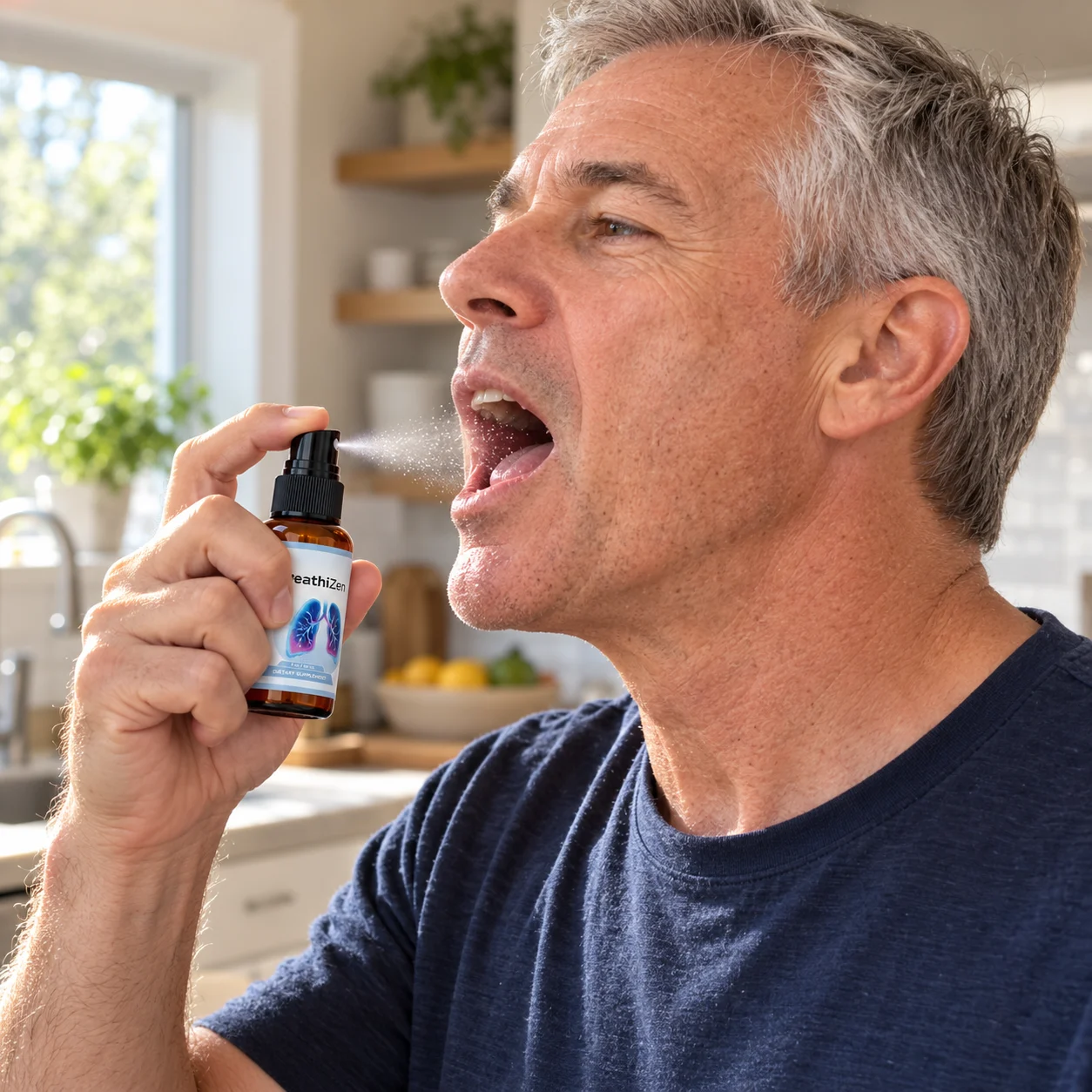
Three Botanicals, Once a Day
Packages from $49 a bottle, every one with the same 60-day guarantee.
See Package PricingThese statements have not been evaluated by the Food and Drug Administration. BreathiZen® is a dietary supplement and is not intended to diagnose, treat, cure or prevent any disease. Nothing here is medical advice. Prices, shipping and guarantee terms are set by the official retailer and confirmed at checkout. Speak to your doctor before starting any supplement.
← Back to all articles